One Drink Funny Cross Stitch Pattern: A Business Review
When I first opened the One Drink Funny Cross Stitch Pattern, I was looking at it through the lens of a professional embroidery designer who has spent years evaluating digital embroidery files for small business merch, branded patches, and custom apparel. The title alone tells you this is a design with a personality—playful, unapologetic, and conversational. The description confirms that it uses only full stitches and is suitable for beginners and experienced stitchers alike. That immediately signals a clean, accessible structure that can translate well into machine embroidery designs, provided the scaling and stitch density are handled correctly. For a small business owner considering this as an embroidery file for apparel or patches, the first impression is one of approachable humor with a handcrafted feel. It does not scream corporate polish, but it does whisper authenticity, which is often more valuable for boutique brands, local cafés, and creative studios.
This review is written from the trenches of production embroidery, where thread colors, hoop size, stabilizer choice, and fabric texture determine whether a design assets or liabilities. I will walk through how the One Drink Funny Cross Stitch Pattern performs in real business scenarios, where it shines, where it demands caution, and how it can elevate your brand identity when used thoughtfully.
First Impressions: Personality Meets Professionalism
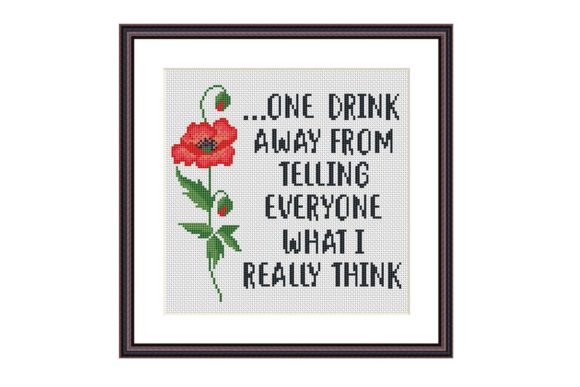
From a design standpoint, the One Drink Funny Cross Stitch Pattern carries a handmade, rustic charm that is hard to replicate with overly digitized graphics. The full-stitch construction means the design is built from clean, uniform blocks of color, which translates to predictable stitch paths and even coverage in machine embroidery. This is a strong advantage for small business merch because it reduces the risk of puckering, thread breaks, or uneven tension during production. The humorous message—about being one drink away from telling everyone what you really think—strikes a chord with customers who value wit and honesty. For a small business like a neighborhood café, a craft brewery, or a boutique bakery, this design can become a signature piece that sparks conversation and builds customer loyalty.
However, professional first impressions also require checking the design's scalability. The One Drink Funny Cross Stitch Pattern is described as simple and suitable for beginners, which suggests that the lettering and graphic elements are not overly intricate. That is a good sign for cap embroidery, where space is tight, and for small patch sizes where detail can get lost. But as with any cross stitch pattern being adapted for commercial embroidery, you must test the thread count and confirm that the text remains legible at reduced dimensions. The design's personality is its strength, but legibility is non-negotiable for branded merchandise.
Real-World Performance Across Business Merchandise
When I evaluate a digital embroidery file for business use, I consider how it performs across multiple product categories. The One Drink Funny Cross Stitch Pattern has a versatile range that fits several common merch formats, but each requires specific attention to placement, sizing, and production techniques.
Embroidered Patches and Apparel Accents
For embroidered patches, this design is a natural fit. The full-stitch structure creates a dense, durable surface that holds up well to edge finishing and repeated handling. Patches are a popular way for small businesses to offer branded merchandise without committing to large inventory runs. The One Drink Funny Cross Stitch Pattern can be digitized as a patch file, stitched on twill or felt, and then applied to jackets, backpacks, or aprons. The humor works well in this format because patches are often used as conversation starters. For a local brewery or a creative studio, this patch could become a collectible item that customers seek out.
On custom apparel like work shirts, hoodies, or caps, the design should be placed as a chest logo or a sleeve accent. The playful tone fits relaxed dress codes, but if your brand targets a more formal market, you may want to reserve this design for special releases or staff-only gear. The embroidery file must be tested at different sizes—typically 2 to 4 inches wide for chest placement and 1 to 2 inches for sleeves or caps. The design's simplicity helps it scale down, but you must verify that the letter spacing does not close up at small sizes.
Tote Bags, Aprons, and Product Labels
For tote bag design, the One Drink Funny Cross Stitch Pattern adds a handmade, approachable element that appeals to eco-conscious customers. Tote bags are a staple for small business merch, and this design's bold message stands out on canvas or cotton. The full-stitch coverage ensures that the design remains visible even on textured fabric, though you may need to adjust the underlay and stabilizer to prevent distortion on heavy tote materials.
Apron embroidery is another strong application. For a café, bakery, or florist, aprons with this design can become part of the staff uniform, reinforcing the brand's personality with every interaction. The humorous message works well in a service environment where customers appreciate a lighthearted touch. In product packaging, such as small labels or hang tags, the cross stitch pattern can be adapted as a printed graphic or a miniature embroidered patch. The key is consistency: if the design appears on multiple touchpoints, it strengthens brand identity and recognition.
Where the Design Demands Careful Execution
No design is perfect for every application, and the One Drink Funny Cross Stitch Pattern has specific limitations that business owners and decorators must respect. The most critical factor is size. Because the design uses full stitches, the stitch count per square inch is relatively high, which can create a dense, stiff area if scaled too small. On cap embroidery, where the curved surface and limited space demand lightweight designs, you may need to reduce the stitch density or simplify the lettering. The same caution applies to small patch sizes under 2 inches. The text may become difficult to read, and the stitches may overlap in ways that obscure the message.
Fabric texture is another variable. On smooth materials like cotton twill or polyester blends, the design performs well. On heavy textured fabrics such as denim, fleece, or coarse linen, the full-stitch blocks can sink into the weave, reducing clarity. You will need to adjust the stabilizer—using a tear-away or cut-away depending on the fabric—and possibly increase the pull compensation to maintain the design's shape. Dark uniforms also pose a challenge: the design's thread colors must contrast sharply with the background. If the thread colors are too similar to the fabric, the humor is lost. Always test with a high-contrast palette before committing to production.
Frequent washing is a concern for any branded apparel. The One Drink Funny Cross Stitch Pattern uses full stitches, which are generally more durable than fractional stitches, but the density can cause the fabric around the design to wear faster. For items that will be laundered repeatedly, such as staff aprons or work shirts, use a high-quality backing and consider a protective overlay or a lower stitch density to extend the life of the embroidery.
Brand Identity and Customer Connection
The One Drink Funny Cross Stitch Pattern is more than a decorative element; it is a statement about your brand's voice. For small businesses, humor is a powerful tool for building emotional connections with customers. This design signals that your brand does not take itself too seriously, that it values authenticity over perfection, and that it welcomes genuine interaction. For a handmade product line, this aligns perfectly with the ethos of craftsmanship and individuality. Customers who buy into this humor are more likely to become repeat buyers and brand advocates.
However, the design must be used consistently across your design assets to reinforce recognition. If you place it on a patch, a tote bag, and an apron, but then use a completely different style on your website or packaging, the visual consistency weakens. Consider creating a printable mockup that shows the design on multiple products before you commit to production. This helps you evaluate how the finished product will appear in your product line and whether it complements your existing brand identity.
From a customer trust perspective, the One Drink Funny Cross Stitch Pattern can increase perceived value when it is executed well. A clean, legible, well-placed embroidered patch or chest logo suggests attention to detail and quality. Conversely, a poorly scaled or misaligned design can undermine that trust. As a designer, I always advise clients to order a single sample piece before running a full batch. This is especially important for commercial embroidery projects where the design may need adjustments to meet production standards.
Practical Embroidery Designer Notes for Production
Before you use the One Drink Funny Cross Stitch Pattern for your business, here are the production steps I recommend based on my experience with similar cross stitch patterns and graphics.
- Test in black and white first. Convert the design to a grayscale or monochrome version to check contrast and readability. If the text is unclear in black and white, it will be even harder to read in color.
- Check the design at small patch size. Digitize the pattern at 2 inches wide and stitch a sample. If the letters are not crisp, increase the size or simplify the font.
- Review thread color contrast. Choose thread colors that stand out against your fabric. For dark uniforms, use bright or metallic threads. For light fabrics, dark or saturated colors work best.
- Inspect spacing and alignment. The full-stitch structure should have consistent spacing between elements. If the design has multiple lines of text, make sure the vertical spacing is even to avoid a cramped look.
- Confirm hoop size. The One Drink Funny Cross Stitch Pattern should fit within a standard embroidery hoop. If you are working with a small hoop, you may need to split the design into multiple hoops, which adds complexity and cost.
- Test on real fabric. Always stitch a sample on the exact fabric you will use for production. This reveals issues with stitch density, fabric texture, and stabilizer performance that cannot be seen in a digital preview.
- Use proper stabilizer. For dense designs like this, a cut-away stabilizer is often recommended for knits and stretch fabrics, while a tear-away works well for wovens. Test both to see which gives the cleanest result.
- Create a mockup for client approval. If you are producing this design for a client, use a printable mockup to show how the design will look on a cap, apron, or tote bag. This reduces misunderstandings and ensures the final product meets expectations.
- Compare it beside other design assets. Place the One Drink Funny Cross Stitch Pattern next to your existing logos, fonts, and graphics to ensure visual harmony. If it clashes, consider adjusting the color palette or placement.
- Confirm commercial licensing before business use. The description does not specify licensing terms, so you must verify that the digital embroidery file or cross stitch pattern allows commercial production. Many patterns are for personal use only, and using them for small business merch could violate the terms. Contact the designer or check the product page for licensing details.
These steps are not optional if you want a reliable, professional result. The One Drink Funny Cross Stitch Pattern has the potential to be a strong asset for your custom apparel and branded merchandise, but only if you invest the time to test and refine the production process.
In summary, the One Drink Funny Cross Stitch Pattern offers a distinctive, humorous voice that can set your small business apart in a crowded market. Its full-stitch construction makes it suitable for machine embroidery design work, provided you pay attention to scaling, contrast, and fabric choice. For patches, caps, totes, and aprons, this design can become a signature element that customers remember and share. Approach it with the same care you would any embroidery file for commercial use, and you will have a finished product that feels authentic, engaging, and professionally crafted.